
About Positive Discipline
Parenting has long swung between two extremes: strict control and permissive freedom. In the search for a better path, educator and psychologist Jane Nelsen developed Positive Discipline, an approach that helps adults guide children with both kindness and firmness. Rooted in the psychology of Alfred Adler and Rudolf Dreikurs, Positive Discipline focuses on teaching life skills rather than relying on punishment or rewards.
At its core, Positive Discipline is based on a simple belief: children do better when they feel better. When children experience a sense of belonging and significance—feeling that they matter and that they are capable—they are far more likely to cooperate, develop responsibility, and contribute positively to their families and communities.
The Foundations of Positive Discipline
Positive Discipline is built on several key principles:
1. Belonging and Significance
Human beings are wired for connection. Children who feel respected, valued, and included develop the confidence and motivation to behave responsibly.
2. Kindness and Firmness at the Same Time
Effective discipline balances warmth with clear limits. Kindness shows respect for the child, while firmness respects the needs of the situation and the adult.
3. Focus on Long-Term Life Skills
Instead of seeking immediate obedience, Positive Discipline helps children develop skills that last a lifetime—such as responsibility, cooperation, problem-solving, and self-discipline.
4. Understanding the Belief Behind the Behavior
Rather than simply reacting to behavior, Positive Discipline encourages adults to ask: What belief might be driving this behavior? Often, misbehavior reflects discouragement or a mistaken belief about how to belong.
5. Encouragement Instead of Praise
Encouragement focuses on effort, improvement, and contribution. It builds resilience and internal motivation rather than dependence on external approval.
Tools and Practices
Positive Discipline provides practical tools that parents and educators can use every day. These include:
- Class meetings and family meetings that teach cooperation and problem-solving
- Natural and logical consequences instead of punishment
- Curiosity questions that help children reflect on their choices
- Connection before correction, strengthening relationships before addressing behavior
- Encouragement that builds confidence and capability
These tools help shift discipline from controlling children to teaching and guiding them.
Why Positive Discipline Works
Research and decades of experience with families and educators show that children thrive in environments where they are treated with dignity and respect while also being held accountable. Positive Discipline avoids the pitfalls of punishment—such as resentment, rebellion, or secrecy—while also avoiding the lack of structure found in permissive parenting.
Instead, it creates a learning environment where mistakes become opportunities for growth.
Children raised with Positive Discipline are more likely to develop:
- Self-discipline
- Responsibility
- Respect for themselves and others
- Strong problem-solving skills
- A sense of connection and contribution
A Global Parenting Approach
Since the first Positive Discipline book was published by Jane Nelsen, the approach has expanded into a worldwide movement. Parent educators, teachers, and therapists across many countries use Positive Discipline to support families and classrooms.
Through workshops, books, and training programs offered by the Positive Discipline Association, the philosophy continues to help adults raise capable, resilient children while maintaining strong, respectful relationships.
The Heart of Positive Discipline
Ultimately, Positive Discipline is not about controlling children—it is about guiding them to become capable and caring human beings. By combining kindness, firmness, and encouragement, adults can create environments where children learn the skills they need to thrive.
As Jane Nelsen often reminds parents and educators:
“Where did we ever get the crazy idea that in order for children to do better, we first have to make them feel worse?”
Positive Discipline offers another way—one that builds connection, capability, and mutual respect.
Unique characteristics of the Positive Discipline Model also include:
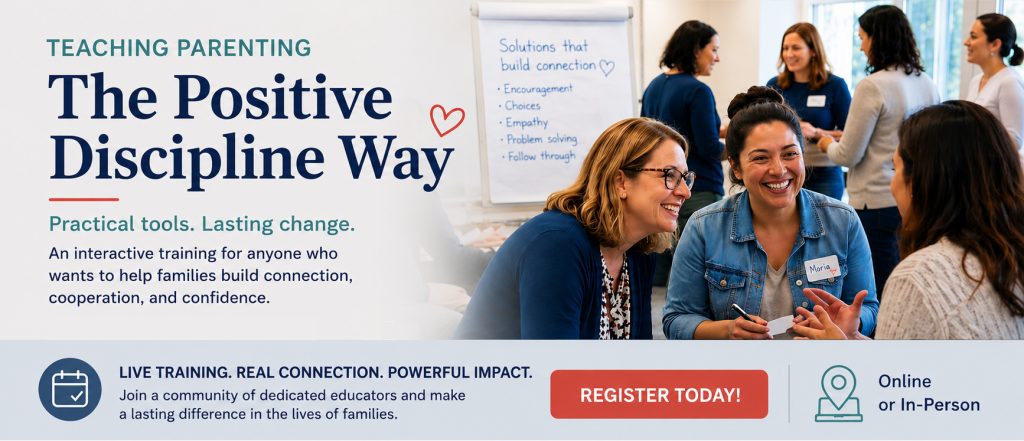
- Teaching adults and students through experiential activities. Creating opportunity to practice new skills and to have fun learning by doing.
- Classroom discipline programs and parent education programs that are consistent. Parents, teachers, and childcare providers can work together to provide a secure, consistent environment for children.
- Inexpensive training and ongoing support so members of communities can teach each other Positive Discipline skills.
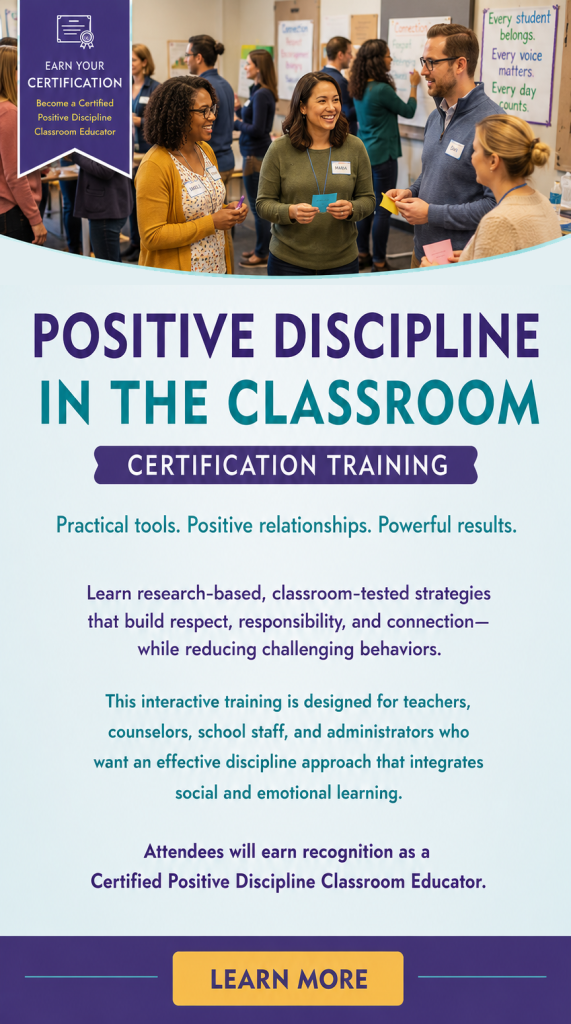
- Certified trainers across the country who can work with schools and communities.
Click Here for more videos on Positive Discipline.
A HISTORY OF POSITIVE DISCIPLINE
The Positive Discipline Parenting and Classroom Management Model is based on the work of Alfred Adler and Rudolf Dreikurs.* Dr. Adler first introduced the idea of parenting education to United States audiences in the 1920s. He advocated treating children respectfully, but also argued that spoiling and pampering children was not encouraging to them and resulted in social and behavioral problems. The classroom techniques, which were initially introduced in Vienna in the early 1920s, were brought to the United States by Dr. Dreikurs in the late 1930s. Dreikurs and Adler refer to the kind and firm approach to teaching and parenting as democratic.
In the 1980s, Lynn Lott and Jane Nelsen attended a workshop facilitated by John Taylor.* Lynn began training interns to teach experientially and wrote (with the help of her interns) the first Teaching Parenting Manual. Jane was the director of Project ACCEPT (Adlerian Counseling Concepts for Encouraging Parents and Teachers), a federally funded project that had received exemplary status while in its developmental phase. Jane wrote and self-published Positive Discipline in 1981. It was published by Ballantine in 1987. In 1988, Jane and Lynn decided to collaborate on the book which is now titled, Positive Discipline for Teenagers, and began to teach parenting and classroom management skills experientially. Lynn and Jane also wrote Positive Discipline in the Classroom and developed a manual filled with experiential activities for teachers and their students.
In the years since, Positive Discipline series has grown to include titles that address different age groups, family settings, and special situations. Positive Discipline is taught to schools, parents, and parent educators by trained Certified Positive Discipline Associates. Community members, parents, and teachers are encouraged to become trained facilitators and to share the concepts of Positive Discipline with their own groups.
Positive Discipline parent education classes are taught across the country, and Positive Discipline is successfully used as the classroom management model in private, religious, and public elementary schools. A demonstration school program is currently being developed.
THE EVIDENCE FOR POSITIVE DISCIPLINE
Formal evaluation comparing Positive Discipline Schools with schools using other discipline programs is just beginning. However, studies of implementation of Positive Discipline techniques have shown that Positive Discipline tools do produce significant results. A study of school-wide implementation of classroom meetings in a lower-income Sacramento elementary school over a four-year period showed that suspensions decreased (from 64 annually to 4 annually), vandalism decreased (from 24 episodes to 2) and teachers reported improvement in classroom atmosphere, behavior, attitudes and academic performance. (Platt, 1979) A study of parent and teacher education programs directed at parents and teachers of students with maladaptive behavior that implemented Positive Discipline tools showed a statistically significant improvement in the behavior of students in the program schools when compared to control schools. (Nelsen, 1979) Smaller studies examining the impacts of specific Positive Discipline tools have also shown positive results. (Browning, 2000; Potter, 1999; Esquivel) Studies have repeatedly demonstrated that a students perception of being part of the school community (being connected to school) decreases the incidence of socially risky behavior (such as emotional distress and suicidal thoughts / attempts, cigarette, alcohol and marijuana use; violent behavior) and increases academic performance. (Resnick et al, 1997; Battistich, 1999; Goodenow, 1993) There is also significant evidence that teaching younger students social skills has a protective effect that lasts into adolescence. Students that have been taught social skills are more likely to succeed in school and less likely to engage in problem behaviors. (Kellam et al, 1998; Battistich, 1999)
Although specific studies of the Positive Discipline parenting program are in the early stages, programs similar to Positive Discipline have been studied and shown to be effective in changing parent behavior. In a study of Adlerian parent education classes for parents of teens, Stanley (1978) found that parents did more problem solving with their teens and were less autocratic in decision making. Positive Discipline teaches parents the skills to be both kind and firm at the same time. Numerous studies show that teens who perceive their parents as both kind (responsive) and firm (demanding) are at lower risk for smoking, use of marijuana, use of alcohol, or being violent, and have a later onset of sexual activity. (Aquilino, 2001; Baumrind, 1991; Jackson et al, 1998; Simons, Morton et al, 2001) Other studies have correlated the teens perception of parenting style (kind and firm versus autocratic or permissive) with improved academic performance. (Cohen, 1997; Deslandes, 1997; Dornbusch et al, 1987; Lam, 1997).
*Alfred Adler (1870 – 1937) was a Viennese psychiatrist who immigrated to the United States. Though a contemporary of Freud, he promoted a substantially different view of human behavior. Adler believed that behavior is not driven by events in the past, but moves toward a goal of belonging and significance that is influenced by each individuals decisions about themselves, others, and the world. Rudolf Dreikurs (1897 – 1972), also a Viennese psychiatrist, was the director of one of the child guidance centers in Vienna that used Adlers methods with families and classrooms. He immigrated to the United States to avoid Nazi persecution in 1937, earlier in his career than Adler. Dreikurs was one of the first people to recognize the benefits of groups in therapy. He was a tireless advocate for relationships based on mutual respect, both at home and at school. His well known books include Children the Challenge, Maintaining Sanity in the Classroom, The Psychology of the Classroom.
*John Taylor lives and works in Oregon. He is author of Person to Person: Awareness Techniques for Counselors, Group Leaders, and Parent Educators. (1984) R & E Publishers, Saratoga, CA.